Tuesday, April 14, 2015

Confederate Tongue

Well, having just restored a wreath, it is more than appropriate that I post a restoration of a tongue portion to a two-piece buckle.  This is a marriage of two buckles to make one.  The loop, or keeper portion and the tongue were recovered in different soil types so a color match had to be performed to make this look right.  This involved going redder with the loop after it was attached.

I'm often asked how long these take to complete.  As you can imagine, it varies.  This marriage took about three hours.  The remaining tab of brass on the keeper was ground down to make a tab insert, much like a biscuit used in woodworking.  After cutting off the remaining keeper from the tongue, I drilled out a corresponding recess into which the other keeper could be inserted, glued and matched. This takes time.

Monday, April 13, 2015

Confederate Saddle Shield

I was asked to put this rare Confederate relic back to display condition.  In addition to being a puzzle, the challenge is to keep it as original as possible.  I left some of the bends and creases in the relic so as to retain some originality.  A good looking and hard-to-find saddle shield that should hold together for a long time,


Confederate Wreath

I received for restoration the brass wreath portion of a 2-piece CS belt rig that had a twist/bend/break and the collector asked that I perform the repair and restoration.

The challenge with these is threefold.  Bend out the brass without breaking and align the pieces.  Secondly, drill out cavities in both pieces in order to insert a shim to bridge for a strong connection. There is little brass to work with so the smallest of drill bits are used (breaking several in the process). Thirdly, matching the existing green where the repairs have been made.

Below are the results of several hours on the bench.


Sunday, March 1, 2015

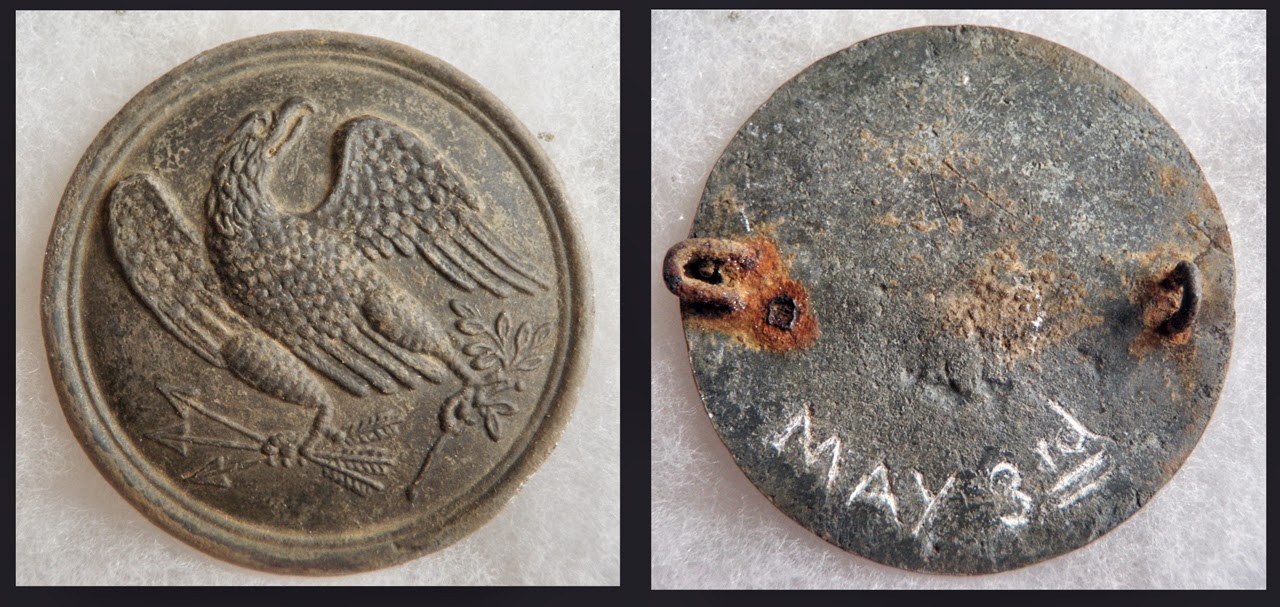
A Date of Some Import

I was tasked with removing a heavy calcium crust that covered the entire face of this federal eagle plate.  The crust often grows and bonds to the brass when plates such as this are lost in low,damp areas.  While this is a beautiful relic in and of itself, the fact that the soldier etched a date on the back, a date that must have held significance for him, makes this a neat piece of history.

On May 1, 1863 General Robert E. Lee left General Jubal A. Early's division to hold Fredericksburg, while marching with the rest of the army to meet Union Gneral Hooker's main offensive thrust at Chancellorsville.  On May 3, the Union VI Corps under Sedgewick, reinforced by John Gibbon's II Corps division, having crossed the Rappahannock River, assaulted and carried the Confederate entrenchments on Marye's Heights.  The outnumbered Confederates withdrew and regrouped west and southeast of the town.

The relic was recovered in Fredericksburg, VA.

Tuesday, February 24, 2015

Camp-made Counterfeit

The counterfeiting of coins has been going on since ancient times.  No surprise then that some creative , and financially strapped soldiers in our Civil War used their spare time to make spare change. Shown below is a lead half dollar that when freshly poured and minted from a crude mold, would have looked very much like the real thing to someone unused to handling such a large denomination. I was asked to bring out the detail of this relic and have done so by first adding a uniform ground coloration then dusting with white, lead oxide.  Prior to this, and upon first glance, this special relic appeared to be little more than a lead disc as seen in the bottom pre-restoration photo.


Monday, February 23, 2015

Rust Removal and Soldier Scratchings

While removing rust from a breakthrough area on the face of this eagle plate, I noticed etchings on the backside.  The soldier looks to have carved a flag and perhaps some other items as well.  Camp boredom was a huge problem and many a soldier turned idle hands to carving whatever was handy.


Tuesday, January 27, 2015

Returning an Over-cleaned Relic to As-Dug Condition

Here is an example of an over-cleaned Virginia coat button. A wire brush, or more likely, coarse steel wool was used to remove the 155 year old patina. Back in the day this harsh treatment may have been acceptable.  Nowadays, anything coming out of the ground is minimally cleaned and certainly never shined.  The only plus side of this over-clean was how it created the contrast of the details by hi-lighting them against the dark verdigris of the oxidized brass in the recesses.

I used a patination acid to oxidize the exposed brass and added a bit of dust to match this to another button the collector cited as coming from the same soil.

Some details are no longer as visible in the re-patinated version with the loss of the contrast but all details remain physically intact. Patination does not corrode away but leaves a thin salts layer when reacting with the raw metal. All details can be "brought out" as desired by selectively rubbing them up a bit. Doing so however would probably wear through to the underlying brass so I will leave this option to the collector.