After probing for some time, I felt the distinctive crunch of rocks at about the two-foot level. Digging down put me on a hut with lots of ash, broken glass and bone. Sticking with it and digging out to its perimeter yielded many nice artifacts including an umbrella ink. The video of the find can be viewed below.

Relic Recovery and Restoration by Roland Frodigh
Thursday, July 30, 2015


Tuesday, June 30, 2015
Hut Excavation & Relics
After months of probing out hut sites and coming up with little to show, I finally got into one that yielded several complete bottles and a few other nice relics. I had been surface hunting with great success and hoping to get into a deep cache of relics that often comes with huts. The US buckle was the signal that put me on the hut. Next to the buckle were remains of a soldiers kepi (cloth and buckle) as well as his powder flask.


The shot below shows the recovery of a nice black-glasss Hostetter's bitters pulled from between two rocks adjacent to the firepit.

The short clip below is of the complete canteen that lay next to the soldier's firebox.
Sinking a test hole to find the edge of the hut ,opposite the corner where the initial finds were made, put me on yet more glass. The clip below shows a medicine bottle recovery. More would follow.
In this video, I've just scraped away the dirt, just to the right of my hand in the video still above and inches from the medicine bottle, exposing the embossed panel of a flask. The question, as always, is...intact or broken? My sister was there to record the recovery.

A return visit to the hut firepit yielded the RRR Radway below


Tuesday, April 14, 2015
Confederate Tongue
Well, having just restored a wreath, it is more than appropriate that I post a restoration of a tongue portion to a two-piece buckle. This is a marriage of two buckles to make one. The loop, or keeper portion and the tongue were recovered in different soil types so a color match had to be performed to make this look right. This involved going redder with the loop after it was attached.
I'm often asked how long these take to complete. As you can imagine, it varies. This marriage took about three hours. The remaining tab of brass on the keeper was ground down to make a tab insert, much like a biscuit used in woodworking. After cutting off the remaining keeper from the tongue, I drilled out a corresponding recess into which the other keeper could be inserted, glued and matched. This takes time.


I'm often asked how long these take to complete. As you can imagine, it varies. This marriage took about three hours. The remaining tab of brass on the keeper was ground down to make a tab insert, much like a biscuit used in woodworking. After cutting off the remaining keeper from the tongue, I drilled out a corresponding recess into which the other keeper could be inserted, glued and matched. This takes time.
Monday, April 13, 2015
Confederate Saddle Shield
I was asked to put this rare Confederate relic back to display condition. In addition to being a puzzle, the challenge is to keep it as original as possible. I left some of the bends and creases in the relic so as to retain some originality. A good looking and hard-to-find saddle shield that should hold together for a long time,


Confederate Wreath
I received for restoration the brass wreath portion of a 2-piece CS belt rig that had a twist/bend/break and the collector asked that I perform the repair and restoration.


 The challenge with these is threefold. Bend out the brass without breaking and align the pieces. Secondly, drill out cavities in both pieces in order to insert a shim to bridge for a strong connection. There is little brass to work with so the smallest of drill bits are used (breaking several in the process). Thirdly, matching the existing green where the repairs have been made.
Below are the results of several hours on the bench.


Below are the results of several hours on the bench.
Sunday, March 1, 2015
A Date of Some Import
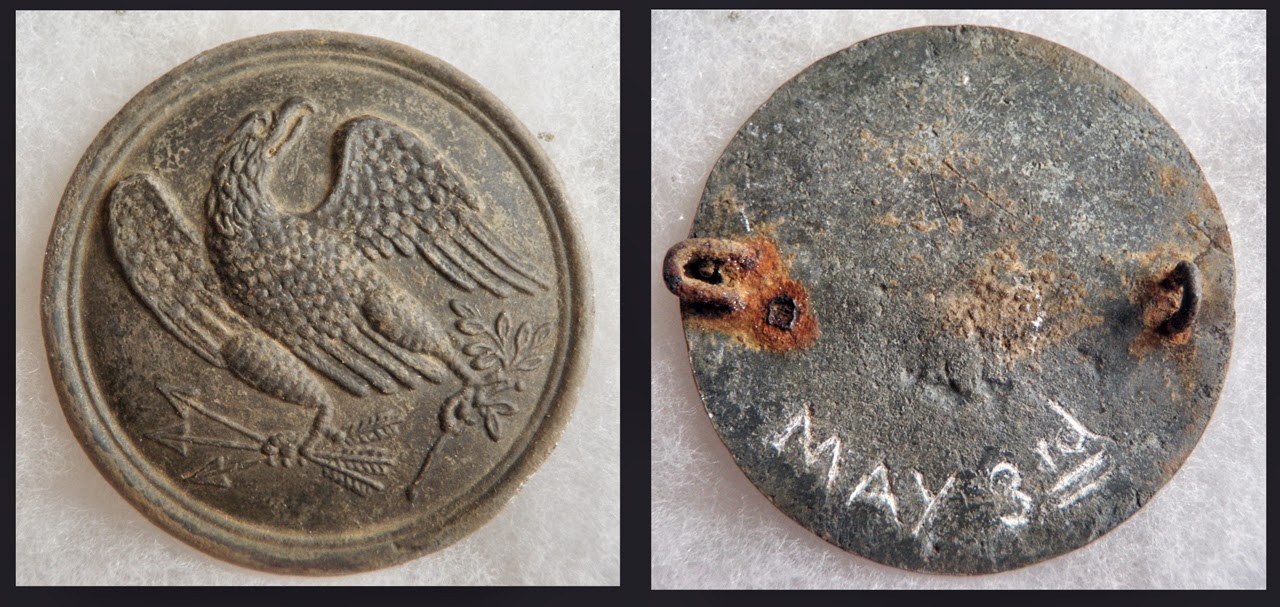
On May 1, 1863 General Robert E. Lee left General Jubal A. Early's division to hold Fredericksburg, while marching with the rest of the army to meet Union Gneral Hooker's main offensive thrust at Chancellorsville. On May 3, the Union VI Corps under Sedgewick, reinforced by John Gibbon's II Corps division, having crossed the Rappahannock River, assaulted and carried the Confederate entrenchments on Marye's Heights. The outnumbered Confederates withdrew and regrouped west and southeast of the town.
The relic was recovered in Fredericksburg, VA.
Tuesday, February 24, 2015
Camp-made Counterfeit
The counterfeiting of coins has been going on since ancient times. No surprise then that some creative , and financially strapped soldiers in our Civil War used their spare time to make spare change. Shown below is a lead half dollar that when freshly poured and minted from a crude mold, would have looked very much like the real thing to someone unused to handling such a large denomination. I was asked to bring out the detail of this relic and have done so by first adding a uniform ground coloration then dusting with white, lead oxide. Prior to this, and upon first glance, this special relic appeared to be little more than a lead disc as seen in the bottom pre-restoration photo.


Subscribe to:
Comments (Atom)